ENT (Ear, Nose & Throat) care focuses on conditions affecting the head and neck region, including infections, gland disorders, and structural or vascular abnormalities. These issues can impact breathing, hearing, swallowing, and overall comfort if not treated effectively.
Dr. Ravi Manek offers advanced, minimally invasive, image-guided procedures to diagnose and treat ENT-related conditions with high precision. Treatments such as biopsies, drainage, and targeted embolization provide accurate results while minimizing discomfort and avoiding major surgery.
With a patient-focused approach, these procedures ensure faster recovery, reduced complications, and effective long-term relief, helping patients regain normal function and improve their quality of life.
Epistaxis is the medical term for a nosebleed, which is relatively common and refers to bleeding from the nose. A nosebleed may be caused by a number of things, including blunt trauma, infections, tumours and the structure of your nose.
Epistaxis embolisation is a minimally invasive procedure in which the blood vessel is deliberately blocked in order to stop the nosebleed.
The aim of the procedure is to stop the blood flowing into the vessels which cause the nosebleed, without preventing blood from flowing into the area around the affected vessel.
The aim of the procedure is to stop the blood flowing into the vessels which cause the nosebleed, without preventing blood from flowing into the area around the affected vessel.
The main reason to treat nosebleeds is the risk of breathing in blood, as if too much blood is inhaled there is a risk of death.
Nasopharyngeal angiofibroma is a tumor that grows behind the nose. Although it is a benign tumor (not cancerous), it is aggressive and serious. It can spread from the nasal cavity to the sinuses, eye socket, skull and brain.
The nasopharyngeal angiofibroma tumor is made mostly of blood vessels, which can result in frequent nosebleeds. The condition is also called juvenile nasopharyngeal angiofibroma (JNA) because the vast majority of these tumors grow in adolescent males. Doctors also call it juvenile angiofibroma (JA).
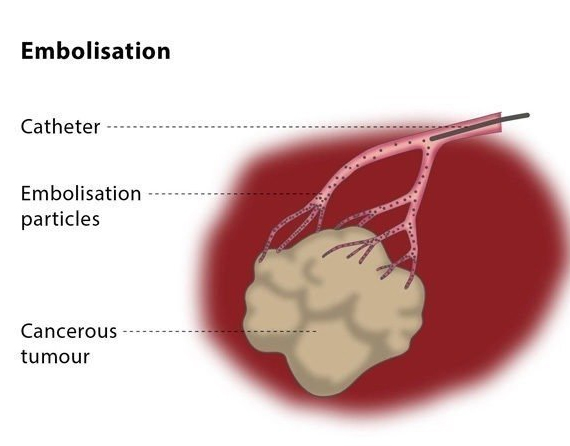
Tumours need a consistent supply of blood in order to grow. Embolisation is a minimally invasive procedure performed by interventional radiologists, in which the blood supply to masses or vessels which are causing symptoms in a patient is cut off, relieving the symptoms the patient experiences.This involves using liquid, particles or microspheres to block blood vessels, redirecting blood flow away from the tumour. This causes the tumour to shrink and die.
Needle biopsy/FNAC is a medical test performed by interventional Radiologists/Radiologists to identify the cause of a lump or mass, or other abnormal condition in the body.
During the procedure, the doctor inserts a small needle, guided by USG, CT or other imaging techniques, into the abnormal area.
A sample of tissue is removed and given to a pathologist who looks at it under a microscope to determine what the abnormality is — for example, cancer, a noncancerous tumor, infection, or scar.
Graves’ disease, the most common cause of hyperthyroidism, is an autoimmune disorder in which autoantibodies targeting thyroidstimulating hormone (TSH) receptors stimulate the receptors so that excessive thyroid hormones are produced . The disease is characterized by hyperthyroidism, goiter and, in some cases, ophthalmopathy. Currently, three established modalities to treat this disease exist: surgery, radioactive iodine, and antithyroid medication. However, these three therapies all have some limitations and disadvantages.
Medication, consisting of antithyroid drugs for 12 to 18 months, has a major disadvantage with a high relapse rate between 20% and 75%.
The use of radioactive iodine is associated with delayed onset and a high cumulative hypothyroid incidence over 10 years greater than 70%.
Although surgery offers the advantage of quick control of hyperthyroidism and in experienced hands carries extremely low morbidity, it may be complicated by recurrent laryngeal nerve injury or permanent hypoparathyroidism after near-total thyroidectomy. With the considerable progress made in endovascular technology in recent years, there has emerged a therapy for Graves’ disease through thyroid arterial embolization. This approach involves embolization of most of the thyroid tissue to reduce its thyroid hormone secretion, hence restoring the patient to euthyroidism. To date, clinical experience with this therapy has been minimal. The aim of this study was to report our initial experience in treating selected patients with hyperthyroidism caused by Graves’ disease with thyroid arterial embolization.
Needle biopsy/FNAC is a medical test performed by interventional Radiologists/Radiologists to identify the cause of a lump or mass, or other abnormal condition in the Thyroid gland.
During the procedure, the doctor inserts a small needle, guided by USG, CT or other imaging techniques, into the abnormal area.
A sample of tissue is removed and given to a pathologist who looks at it under a microscope to determine what the abnormality is — for example, cancer, a noncancerous tumor, infection.