
The carotid arteries are the two large arteries on each side of your neck that supply your brain, neck and face with oxygenated blood. Sometimes plaque builds up in the arteries, which results in a condition called carotid artery stenosis (also known as carotid artery disease). Stenosis means that the space inside the artery has narrowed, restricting blood flow.
Carotid artery stenting (CAS, also referred to as carotid artery angioplasty with stenting) is a minimally invasive treatment option for effectively managing carotid artery stenosis and preventing stroke. It is a non-surgical treatment in which catheters (thin hollow tubes) are used to place a stent (a metal mesh tube) in the affected artery to ensure the passage stays clear, thus restoring blood flow.
While some patients with carotid artery stenosis have no symptoms, the condition can lead to the formation of blood clots (thrombosis), mini-strokes (which are similar to strokes but only last a few minutes) and strokes (where the artery supplying blood to the brain is blocked). The CAS procedure is a possible alternative for patients for whom the traditional surgical option, carotid endarterectomy (CEA), may not be suitable.
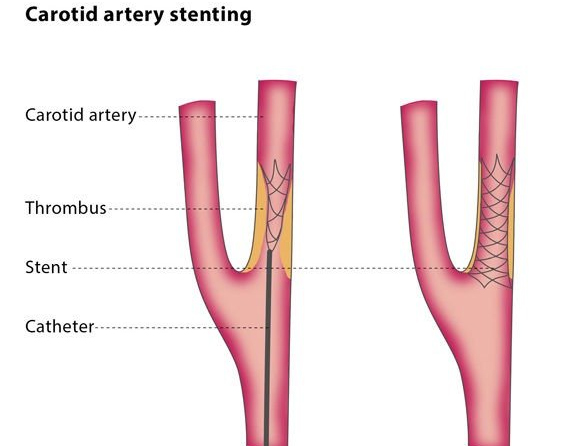
You will be given a local anaesthetic for the procedure. Using fluoroscopy to monitor and guide the process, the interventional radiologist will puncture an artery in your groin or arm with a needle, and will insert a balloon-tipped catheter into the carotid artery, guiding the catheter into the narrowed area. The balloon will then be inflated and deflated, compressing the fatty plaque or blockage against the artery walls, widening the blood vessel and increasing blood flow. After this, the balloon will be removed.
The interventional radiologist will use another catheter to place a stent, and, in some cases, will further expand the stent using another balloon-tipped catheter. The stent remains in place so that there is a clear passage in your artery.
CAS may be an appropriate treatment for you if you have symptoms of carotid artery disease and are at increased risk of suffering complications from surgery. It may be beneficial if you have undergone traditional surgery but your arteries have become re-narrowed (called restenosis), if the location of the narrowing in the artery means it cannot be operated on or if narrowing has occurred following radiation treatment. It may also be considered as a treatment for you if you have no symptoms of carotid artery disease but are awaiting surgery for carotid stenosis.
Powered by Dr. Ravi Manek | Designed and Developed by MS Expert