
The aorta is the largest vessel in your body and carries the blood from your heart to the rest of your organs. An aneurysm occurs if the arterial wall weakens and develops a bulge, meaning blood is flowing to the weakened area. Abdominal aortic aneurysms (AAA) are also known as ‘the silent killer’ because once they grow and rupture, there is an 80-90% risk of immediate death.
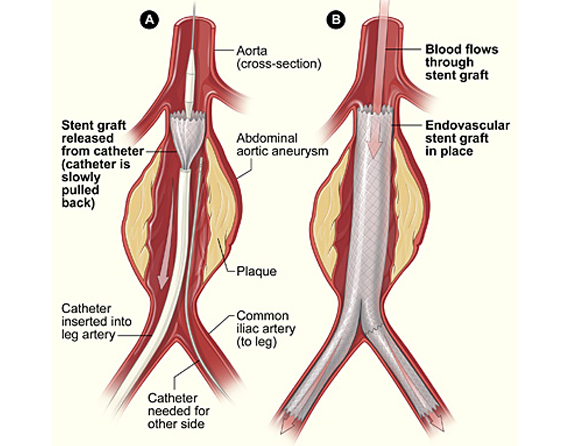
EVAR is a minimally invasive procedure in which an interventional radiologist places a covered stent (a metal mesh tube covered with fabric) into the area with the aneurysm so that blood can flow through the vessel. The stent is inserted through an artery in the patient’s groin, using X-rays to guide the stent to the aneurysm.
If you have a small AAA that has a diameter of less than 5 cm, it is unlikely to rupture, so it is recommended that the aneurysm is regularly monitored by a vascular expert. If, however, you have an aneurysm that is smaller than 5 cm but it is growing by more than 1 cm every year or it is causing symptoms such as back pain and tenderness, EVAR may be beneficial for you.
If your aneurysm is larger than 5 cm, you will need treatment to prevent the aneurysm from rupturing. EVAR is a possible treatment option.
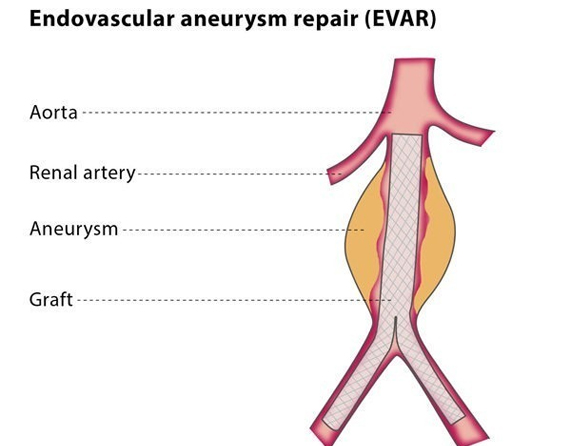
You will be given a combination of an epidural and a local anaesthetic for the procedure. The interventional radiologist will make a small cut at the top of each leg so that they can insert a short tube (known as a sheath), which allows the vessels in your groin to be accessed safely. Using fluoroscopy for guidance, the interventional radiologist will insert guidewires and catheters (thin flexible tubes). A contrast medium (dye) will be injected into the area being treated so the exact location of the aneurysm can be seen under imaging. The interventional radiologist will then use the guidewire to move a stent to the aneurysm.
When the stent is placed in the correct location, it will expand, sealing the aneurysm and restoring normal blood flow through the vessel.
After the procedure, your vital signs will be monitored and you will stay in hospital for 2-3 days. You may experience bruising and pain, though this can be treated with standard painkillers. Moving around once you are able to do so is encouraged. You will need to have the stent regularly checked using CT or ultrasound to ensure that it is in good condition and to avoid long-term problems.
Powered by Dr. Ravi Manek | Designed and Developed by MS Expert